
We Are Not Talking About the Same AI
A small group of intensive AI users is moving ahead in what it knows is possible and what it does with models—even as AI use spreads.
A person who uses AI to tidy up an email and a person who asks it to change a working piece of software can both say, honestly, that they use AI. The same words now cover very different experiences.
For the first person, AI may still mean a box that answers questions. For the second, it may mean a system that reads files, writes code, runs tests, sees what failed and tries again. This is what an AI agent does: it uses tools and carries a task through several steps, rather than stopping after an answer. A person gives it a goal and checks the work, but does not have to type every next instruction.
That difference is easy to miss from the outside. The screen may still contain a conversation. The person may still begin by typing a sentence. Yet behind that familiar screen, the machine can be doing hours of work that an earlier chatbot could only describe.
My concern is that a very small group of intensive users is moving further ahead of the rest of society in what it knows is possible and what it actually does with models. Even within that group, there is a narrower frontier: people who keep pushing the tools into longer, harder tasks while other regular users stay with familiar uses.
Who is paying for AI
The a16z State of Markets II chart gives us one precise starting point. It reports that 2.2% of US households had paid AI subscriptions in April 2026. The article, published September 30, rounds this to “~2%.” The chart credits PNC Research's internal data, dated July 13, 2026.
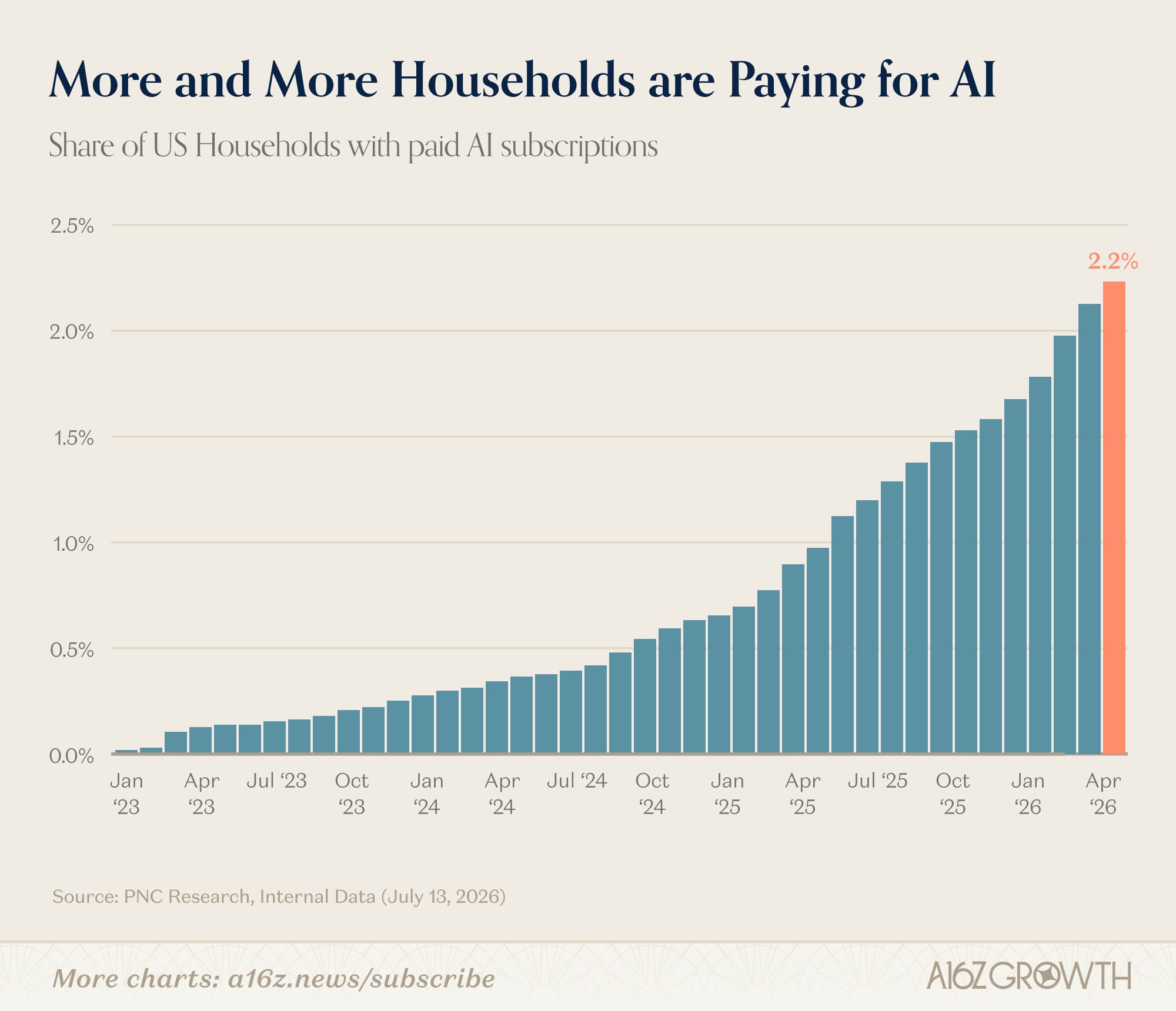
Figure 1. Share of US households with paid AI subscriptions: 2.2% in April 2026. Original chart, credited to PNC Research, Internal Data (July 13, 2026). This is not the share of people using AI. Chart; a16z's accompanying article, September 30, 2026.
People can use AI for free, through work or inside another product without paying for a personal subscription. Paying for one does not tell us how deeply they use it.
The more interesting distinction runs through AI use itself. Trying a chatbot, relying on it every day and building your work around long-running agents are different experiences. Within regular use, some people go much further: they connect models to files and tools, leave substantial jobs running and learn how to check what comes back.
If your main encounter is a chatbot rewriting a message, you learn something real: it can produce fluent text, sometimes useful and sometimes wrong. Nothing in that encounter necessarily shows you that it can inspect a software project, find a problem, make a change and check the result. Reading another headline about AI does not fill in those missing steps.
Nor does using it often guarantee that you see them. You can become good at asking questions without ever asking the system to do a longer job. The use that already fits your day becomes your definition of the tool. You stop searching for abilities you do not know are there.
That is how broad adoption can coexist with a sharp tip of extreme use. More people can enter at the familiar end while a much smaller group moves further out.
What the newest systems can do
On September 22, Anthropic released Claude Opus 5.5. The details of its reported work are more useful here than another ranking of model scores.
In an internal test, Anthropic asked it to rewrite HAProxy, software that distributes web traffic across servers, from the C programming language into Rust. The run took 9.5 hours. The resulting version passed nearly all of HAProxy's own regression tests: checks intended to catch things that stop working after a change.
Passing those tests does not mean the rewrite is ready to replace a live system. It does mean that the task was much larger than answering a programming question. The model was carrying a substantial body of software through a change and producing something that could be tested.
The same launch included a report from Clio developer Sean Heintz. He described giving Opus 5.5 a task across six software repositories and leaving it running overnight. It stayed on task for more than 18 hours, working out how the services should communicate. These are Anthropic's internal tests and selected customer reports, not a promise that every attempt will work this well.
There are examples outside programming, too. In a test involving a proposed merger between two fictional software companies, Opus 5.5 built a financial model in Excel and turned it into a presentation about whether the deal made sense at its price. Anthropic reports that it finished in 63 minutes. The important detail is the sequence: calculate, build the spreadsheet, explain the result in another format.
Someone who has only watched AI compose paragraphs may reasonably find this surprising. The ability to write a convincing explanation is familiar. Here the system moves through files and tools, using the result of one action to choose the next. It leaves behind files a person can open, test and use.
Experienced users learn where that experience holds up. They see which instructions lead to useful work, what needs checking and when starting again is better than continuing. Their expectations come from repeated attempts, including failed ones. That practical knowledge is difficult to get from a product announcement.
This is the advantage of being close to people who build and use these tools intensely, in Silicon Valley or elsewhere. You are more likely to see a real task completed and to learn how it was done. It is not that everyone in one place understands AI, or that everyone outside it does not. Seeing useful work changes the next thing you think to ask for.
The difference can compound. Someone who has learned to supervise an overnight task has a starting point for trying a harder one when the next model arrives. Someone who still thinks of AI as a writing aid may not know that either task is worth attempting. The same release reaches both people, but it does not give them the same practical starting point.
One instruction can start hours of model use
There is another reason a small group can get much further into the technology than a headcount suggests. One person can now set off a great deal of model use without spending the whole time in conversation with it.
A token is a small unit of text a model processes or produces. Your question uses tokens. So does the answer. An agent also processes the contents of files, instructions for using tools, results from earlier actions and material it needs to check. It can do this repeatedly while pursuing one goal.
OpenRouter's Peter Walker reported in August that token volume classified as agentic had grown roughly fourteenfold over about six months, while human-classified volume had grown 2.8 times. An August 21 a16z chart using OpenRouter data put agentic volume at nearly five times human volume. This is classified traffic on one model-routing platform, including cached input, not a count of all AI use worldwide.
The classification has a concrete basis. OpenRouter describes seven signals, including how often tools are called, how many turns a conversation takes and the time between responses. It groups traffic by the access key an application uses, with a separate mixed category. It is not watching every request and discovering whether a human personally intended it.
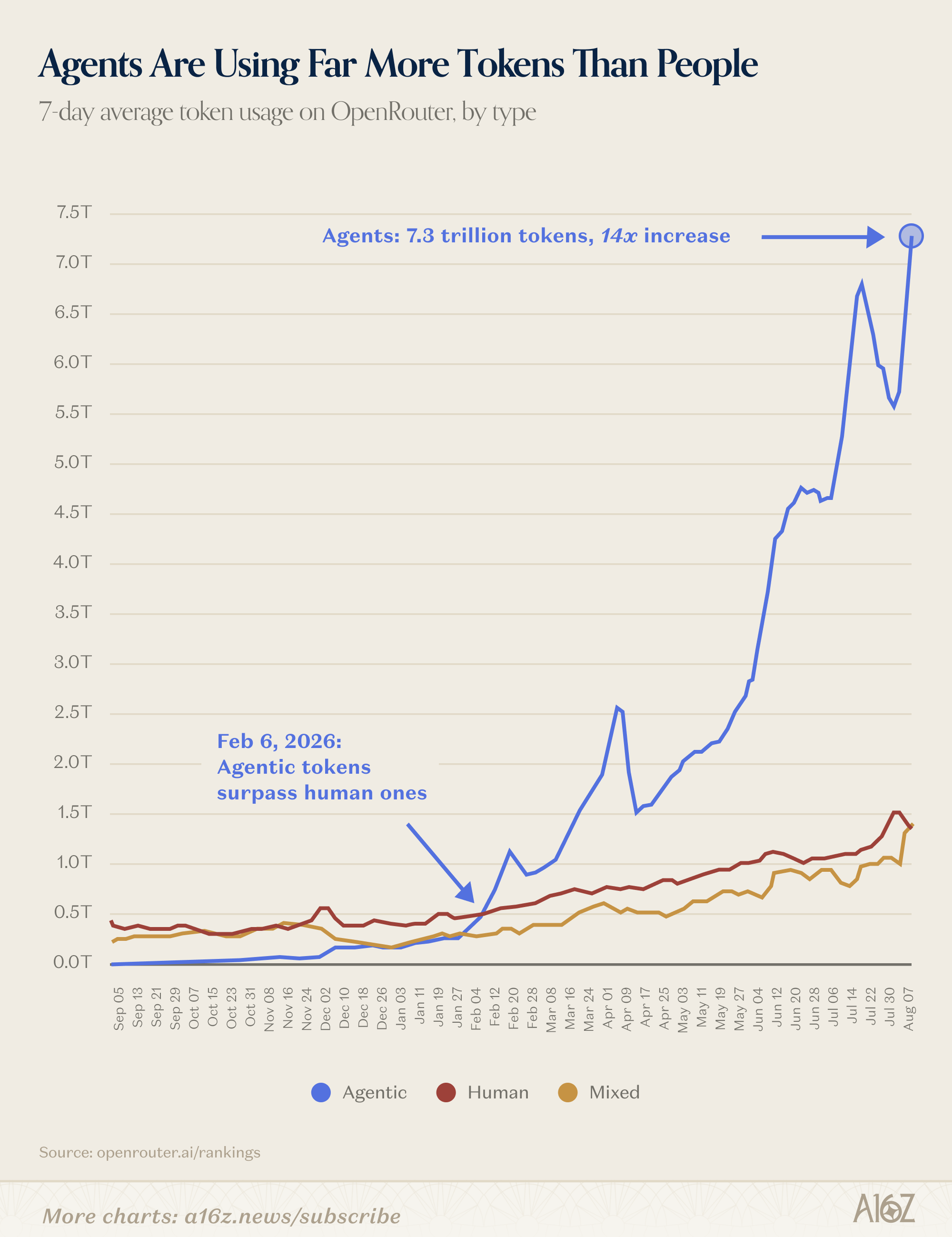
Figure 2. OpenRouter token consumption, 7-day averages through August 7, 2026: Agentic overtakes Human on February 6 and reaches 7.3 trillion tokens. Mixed is a separate category; counts include cached input and cover this platform only. Original chart: OpenRouter/a16z, published August 21, 2026.
Much of this volume comes from reusing material already supplied to the model. Providers can store that material in a cache and charge less to read it again. A large token count therefore does not mean the same amount of new writing, expense or useful work. A system that keeps trying the wrong solution also consumes tokens.
Even so, the figures describe a real change in how the technology is being used. In this kind of work, consumption is no longer tied to how quickly people can type questions and read answers. Software can keep calling models while a person does something else.
That makes the change less visible. You may see someone send a short instruction, but not the files read, tests run and further model calls that follow. Counting people who say they use AI tells us something important about reach. It tells us much less about how much work their use sets in motion.
Where the AI businesses are growing
A different kind of concentration appears in the Stripe chart circulated on September 24. Its title is precise: “Monthly payment volume of AI businesses on Stripe.” It separates businesses by their headquarters, with one line for the United States and another for the European Union.
From January 2023 into 2026, the US line rises steeply. The EU line remains low on the same chart. There is no numerical vertical scale, so the picture supports a clear difference in trajectory, not an exact ratio. It measures payments to those businesses, not where their customers live or how much ordinary Europeans know about AI.
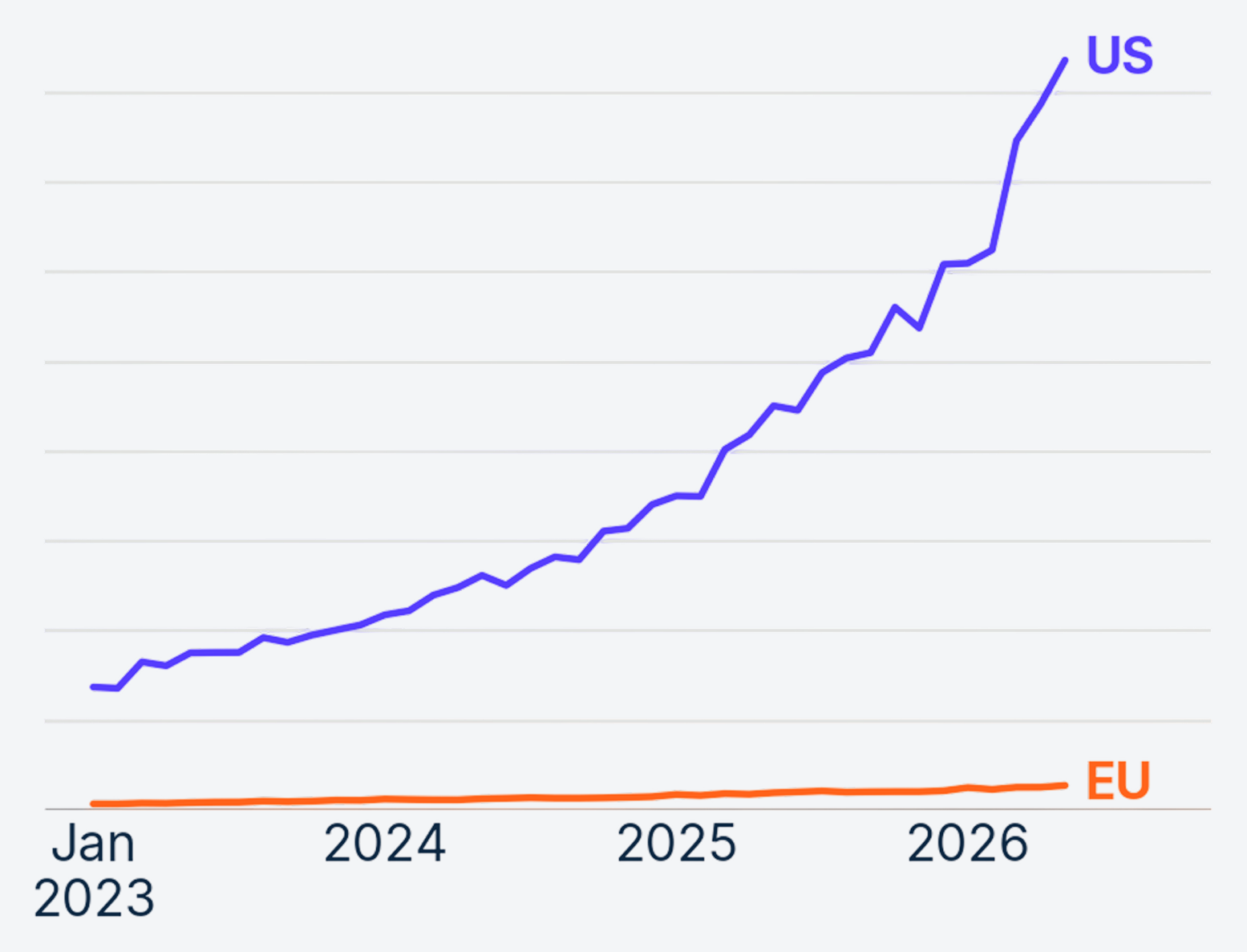
Figure 3. Stripe's original chart: monthly payment volume of AI businesses by headquarters, US versus EU. The vertical scale is unlabelled. Circulated September 24, 2026. Source: Stripe.
A European can use an American AI product every day, and those payments can appear on the US side. The commercial map and the map of people's experience need not look alike.
What it does show is that the visible commercial expansion in this Stripe sample is concentrated among US-headquartered suppliers. People can participate in that expansion as customers without living near the people creating the products.
Being around people who try unfamiliar uses can change what you attempt yourself. Those people may be colleagues, friends or an online community, wherever you live. The small frontier of intensive use does not stop at a national border.
Why the gap does not close by itself
It would be comforting to think that more users will automatically mean a smaller gap. But the number of people using AI can rise while the distance between ordinary use and the most ambitious use grows too.
If a system failed at a task when you tried it, that failure is evidence you earned yourself. A stranger's claim that a new version is much better may sound like the last claim you heard. Without a reason to try again, your judgment can stay fixed while the tool changes.
The reverse problem is real too. A frequent user can start assuming that everyone has seen what they have seen. They skip the explanation of how a task was completed and speak only about the result. To someone outside that daily practice, the claim can sound impossible, exaggerated or like another polished demo.
Both sides then hear the other as unreasonable. One is describing a machine that can carry substantial work forward. The other is remembering a machine that confidently made things up. The disagreement may concern different versions, different tasks and different amounts of help, long before it becomes a disagreement about the future.
And the frontier does not stand still while everyone else catches up. As models improve, people already testing their limits can attempt longer jobs, connect more tools and learn from more attempts. Even other daily users may be far behind that narrower group. This is what I mean by the tip getting sharper: a small group can move further ahead in practice even as AI becomes more common.
The speed of releases makes this harder. There is no final lesson called “what AI can do” that people can learn once. But it is also unreasonable to expect everyone to follow model releases as a second job. People have families, work and interests that do not involve testing software. Their distance from the frontier says little about their intelligence.
What travels most slowly is often the practical demonstration: here was the job, here is what the machine did, here is where it failed, and here is the finished result. That is more useful than either a spectacular prediction or a screenshot of a foolish answer. It gives another person something specific to reconsider.
Discovering it late changes the choices you see
The cost of an outdated picture is not just losing an argument about technology. It is failing to notice an option.
A person may dismiss a project because the first version seems too expensive to build. They may spend days on a task because they know AI can help write the explanation but not that it can help produce the underlying files. They may decide not to learn something because the distance from beginner to useful work still looks as large as it used to. These are possible consequences of missing a capability, not evidence that every task should be handed to a machine.
Earlier discovery gives people more time to experiment before they need a result. They can learn the limits without facing an urgent deadline. Someone who discovers the change only when a colleague, customer or competitor expects more has to learn under pressure. The tool may be equally available to both people by then. Their experience is not.
Late discovery need not mean permanent exclusion. Much of what makes these systems useful is that they can explain unfamiliar steps and help someone attempt work they could not previously start. But that possibility matters only after the person knows to try. Access to a website is a weak substitute for seeing what to do with it.
I think this is the social divide worth paying attention to now: not simply users versus non-users, but a small group developing a much larger sense of what it can attempt, with an even smaller group pushing that practice further. It cuts across borders and professions. It can also run through one office, one group of friends or one household.
The concern is not that the rest of society has never heard of AI. It is that a few people are learning to do things with it that most people, including many users, do not yet know are practical possibilities. As the models improve, that difference can grow rather than disappear.
People deserve a clearer view of that work—not pressure to believe every claim, and not reassurance based on what the tools could do last year. Before we can have a useful shared argument about where AI is taking us, we need to see more clearly what people are already doing with it.
Sources and measurement
Review cutoff: October 4, 2026. The a16z/PNC household chart ends in April 2026; July 13 is its source date and September 30 the article's publication date. Neither discloses the underlying sample methodology. Anthropic's examples are internal tests and selected customer testimony. Stripe groups suppliers by headquarters and gives no numeric vertical scale. OpenRouter covers classified platform traffic, including repeated cached input. The small intensive-user frontier and its growing practical distance from everyday use are the essay's interpretation, not measured population shares or a demonstrated widening trend.